Recently, the research teams of Professors Zhang Chengwu and Liu Wen from our university, in collaboration with Professor Li Lin’s team from Xiamen University, published a research paper entitled“Biomimetic Nanoplatform” for Targeted Glioblastoma Therapy via Concurrently Triggering GPX4/DHODH Mediated Ferroptosis” in Advanced Science (CAS Zone 1 TOP, Impact Factor 14.1)
Dr. Ren Guodong (lecturer, School of Basic Medical Sciences, our university), Wang Xuewei (PhD candidate, our university), and Li Panpan (postdoc, Academy of Flexible Electronics, Northwestern Polytechnical University) are co-first authors. Professors Zhang Chengwu, Liu Wen, and Li Lin are co-corresponding authors. This study developed a biomimetic nanoplatform (MHL@M) that simultaneously inhibits GPX4/DHODH, potently activating ferroptosis through dual pathways and achieving efficient suppression of orthotopic glioblastoma. It provides a novel nanomedicine strategy for precision therapy of glioblastoma. Glioblastoma multiforme (GBM) is one of the most invasive and lethal brain tumors, posing a severe threat to human health. However, traditional treatments show limited efficacy, creating an urgent need for more effective interventions. As a novel cell death mechanism, ferroptosis holds great potential for GBM treatment, yet its efficacy is significantly hindered by the tumor’s inherent anti-ferroptosis defense mechanisms. Moreover, inducing ferroptosis via a single target yields limited effects; simultaneous inhibition of key anti-ferroptosis regulators is required to overcome compensatory pathways and achieve efficient tumor suppression.
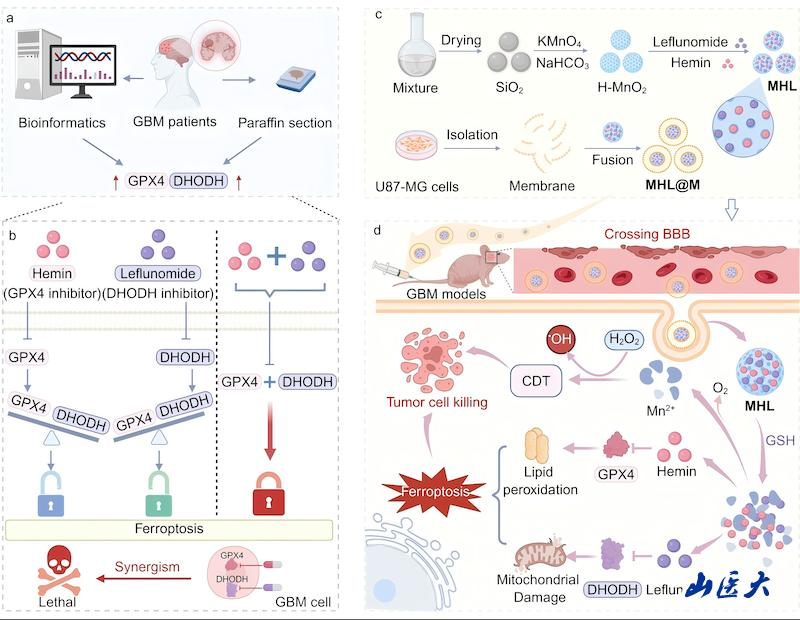
Accordingly, this study constructed a multifunctional biomimetic nanoplatform, MHL@M. Using GBM cell membrane coating technology, the platform gains the ability to cross the blood–brain barrier (BBB) and target tumors. Upon delivery to the tumor site, it depletes overexpressed glutathione in the tumor microenvironment and generates reactive oxygen species. Combined with the GPX4/DHODH inhibitory activity of hemin/leflunomide, it induces a “burst” ferroptosis effect. In vitro and in vivo results demonstrate that MHL@M exhibits excellent tumor targeting, tumor microenvironment responsiveness, ferroptosis activation, and efficient GBM cell-killing performance. This study provides a novel ferroptosis-based strategy for precision GBM therapy. This research was supported by the National Natural Science Foundation of China (22577108), Shanxi Health Commission Research Fund (2021060), Shanxi Basic Research Program (20210302123265), Shanxi Young Scientists Basic Research Program (202203021212366), Fujian Natural Science Foundation (2024J01060), XMU Startup Program, Fundamental Research Funds for the Central Universities, and the Ministry of Education Basic and Interdisciplinary Breakthrough Program (JYB2025XDXM40).
(Text /Photos by Ren Guodong)