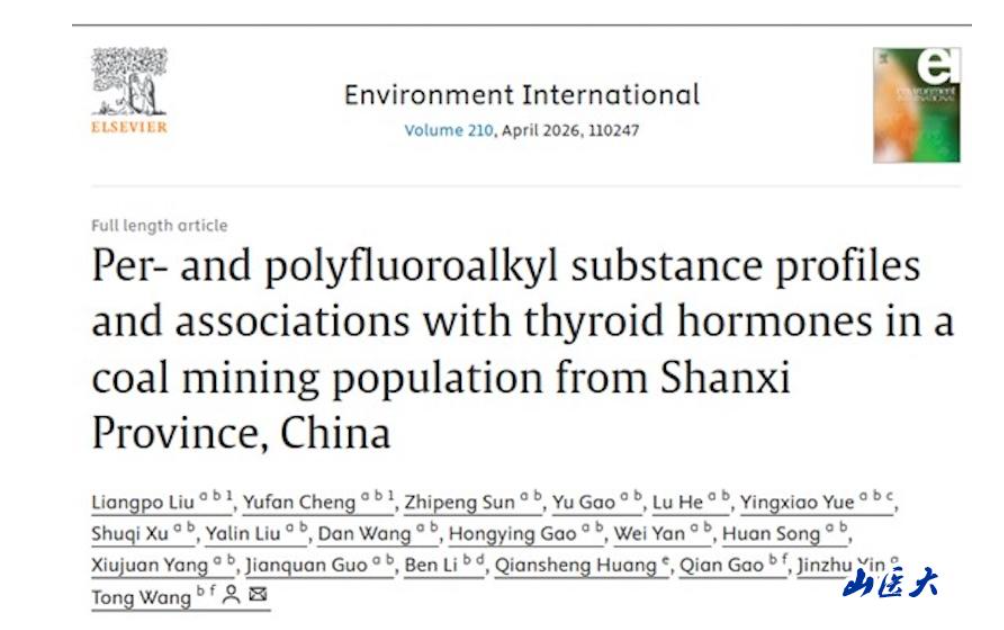
Recently, the team of Associate Professor Liu Liangpo (co-first author) from the School of Public Health of our university, in collaboration with the team of Professor Wang Tong (corresponding author), published a research paper titled “Per- and polyfluoroalkyl substance profiles and associations with thyroid hormones in a coal mining population from Shanxi Province, China” in 《Environment International》, a top-tier journal in environmental science (Chinese Academy of Sciences Category 1 Top, impact factor 9.7). This achievement represents another landmark progress in the construction of the Key Laboratory of Coal Environmental Pathogenicity and Prevention, Ministry of Education, as well as the high-level School of Public Health of our university.
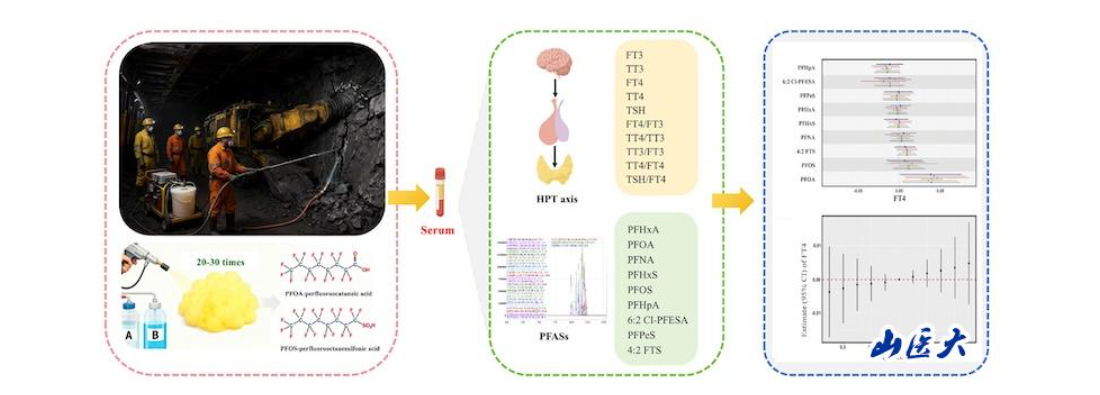
Per- and polyfluoroalkyl substances (PFASs) are a class of persistent endocrine-disrupting chemicals, and their disrupting effects on thyroid hormones remain controversial. Of particular concern is the potential use of PFASs-containing firefighting foams in underground coal mines, which may expose coal miners to potential risks; however, biomonitoring and epidemiological studies targeting this population have been lacking previously. To address this gap, this study, for the first time, focused on the coal mining population and systematically analyzed the exposure characteristics of PFASs and their associations with thyroid hormone levels.
The study adopted a cross-sectional design, measuring 26 PFASs (of which nine had detection rates exceeding 75%) and five thyroid hormone indicators in the serum of the coal mining population. The results showed that PFOA exposure concentrations were extremely high, comparable to those in populations near fluorochemical plants. Novel alternatives (e.g., 4:2 FTS, 6:2 Cl-PFESA, etc.) were widely detected, and compared with legacy PFASs, these novel substances exhibited stronger negative correlations with thyroid hormones (FT3, TT4, etc.). PFAS exposure was also positively correlated with the FT4/FT3 ratio and showed nonlinear dose effects. The study indicates that PFAS exposure is an important risk factor for thyroid dysfunction in the coal mining population.
The team of Liu Liangpo has long been dedicated to research on environmental pollutants and health, with a focus on the development and application of new technologies in sanitary inspection. Their research covers exposure monitoring, in vivo transformation, and health effects of emerging contaminants (e.g., plastic additives, per- and polyfluoroalkyl substances, flame retardants, etc.), as well as the mechanisms of reproductive and developmental toxicity of endocrine-disrupting chemicals. In recent years, as the Director of the National Key Laboratory of Human Biomonitoring, Liu Liangpo has led his team in undertaking projects such as the National Human Biomonitoring System Construction, the National Natural Science Foundation of China, the Shanxi Provincial Basic Research Program, and multiple industry-funded (horizontal) projects. He has also participated as a key member in the National Major Research Plan and the National Key Research and Development Program, among others. The team has published multiple high-level SCI papers, continuously contributing scientific and technological strength to the construction of a high-level School of Public Health.
The team of Wang Tong has long specialized in causal inference and high-dimensional data analysis methods and their applications. Relying on the occupational population exposure cohort in the coal environment of Shanxi Province, the team focuses on the complex exposure characteristics of multiple pollutants and behavioral habits. They have developed various health risk assessment models tailored to coal environment-exposed populations, providing core theoretical support for precise occupational health interventions.
Original link: https://www.sciencedirect.com/science/article/pii/S0160412026002059
(Text and photos by Liu Liangpo)